
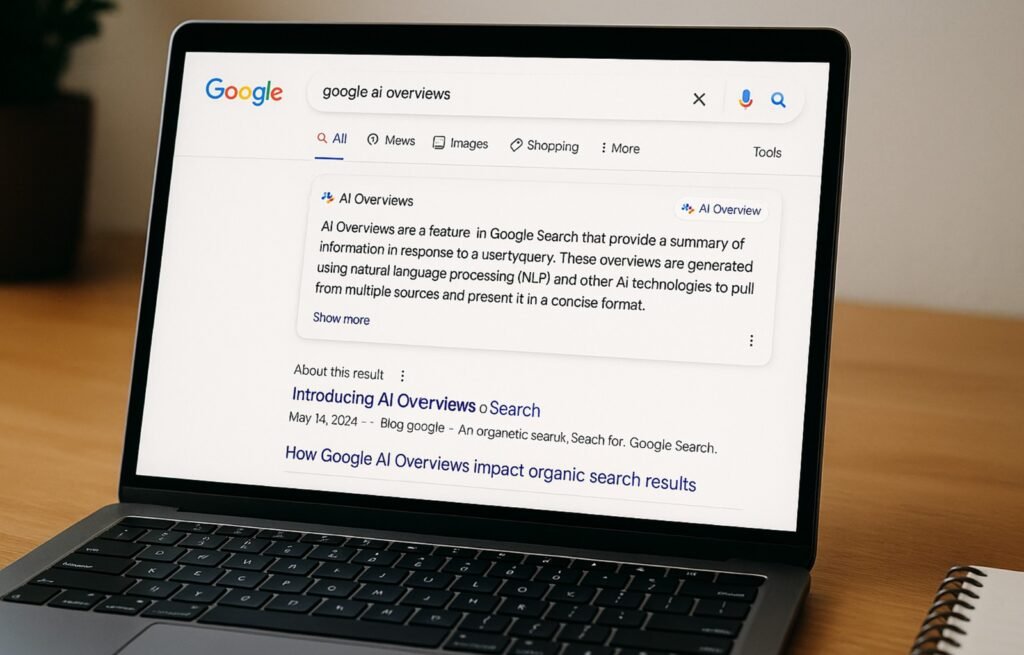
Imagine users typing a question into Google Search and then seeing a neat summary at the top of the page that answers their query instantly, without needing to click. That’s what the AI-generated feature known as AI Overviews (AIO) does. It’s reshaping how content marketers think about visibility, keywords and ranking. In short: your traditional organic-search strategy still matters—but how it works is changing.
How are AI Overviews and Organic Search Results Connected?
At first glance, organic search results and AI Overviews share the same goal: help users find what they’re looking for. But their relationship is evolving in three key ways:
-
Placement shifts: AIO often appears before standard organic listings, meaning your Page 1 result might now come after a summary box.
-
Source overlap: Pages that rank highly in organic results are more likely to be cited in AIOs — but not guaranteed. Some content cited by AIO doesn’t even rank in the Top 10.
-
Click behaviour changes: Because users often find their answer directly in the overview snippet, fewer clicks may go through to your website. That means you may get impressions but fewer visits.
So yes—they’re linked, but the dynamics are shifting.
Insights into Ranking Factors: What AIO Means for Organic Rankings
If you’re used to thinking only about keywords, links and page speed, now you’ll need to layer in considerations specific to AI Overviews:
Authoritativeness and trust:
AIO tends to cite sources it believes are reliable. That means your content must signal credibility if you want it cited.
Diversified SERP features:
Traditional ranking factors still matter, but now you also need to monitor how your content performs withinAIO and adjust accordingly.
In other words: standard SEO remains vital, but simply ranking well no longer ensures you’re visible in the summary box that many users will see first.
How the AIO–Organic Search Overlap Has Changed Over Time
The overlap between content featured in AIO and the pages ranking top-organic has shifted noticeably:
- A study found that prior to a core update, ~16% of organic Top 10 pages overlapped with AIO citations—but that number dipped to ~15% after the update.
- A broader analysis by Semrush revealed that AIO triggered for roughly 13.14% of queries in March 2025 — nearly double compared to earlier in the year.
- Another observation: AIO citations are more volatile. One platform noted that ~70% of cited pages changed within 2-3 months.
What that means: what worked last quarter might struggle this one. Organic and AIO strategies must remain agile.
Organic and AIO Visibility Depend on the Vertical
The impact of AIO differs depending on industry or topic. Here’s what we’re seeing:
- Informational queries lead: Most AIOs appear in queries where users ask “what”, “how”, or “why”—often in categories like health, science, society. Eg: 88.1% of queries triggering AIO were informational.
- Transactional/e-commerce queries less affected... for now: Search terms tied directly to purchasing or brand names are still largely organic-driven. But that gap is narrowing.
- E-commerce signals growing: Even in commerce-related categories, AIO is beginning to surface summaries and related content, not just directory listings or product pages. So e-commerce players can’t afford to ignore this shift.
Bottom line: if your vertical is heavy on informational or research-phase queries, you’re at higher risk of AIO disrupting click-throughs. If you’re more transactional, you still have some breathing room—but it’s shrinking
What Is Going On With E-Commerce?
Here’s what this means specifically for online retailers, marketplaces and brands:
- When users are in early discovery mode (e.g., “best running shoes 2025”), AIO may provide answers that reduce the number of people clicking through to individual product pages. That means potential traffic losses.
- However, there’s also a chance: being cited insidean AIO (or linked by it) can still drive visibility—especially brand visibility—even if the click happens later. So it’s not purely negative.
- For product-listing pages: the strategy shifts from just optimizing for ranking to optimizing for discovery. Rich content (videos, detailed reviews, comparison tables) becomes more important because AIO favours depth.
- Retailers focused solely on “how to buy” content (e.g., “which brand is best”) may see greater disruption, whereas those offering detailed user guides, data-led reviews, or proprietary insights have more resilience.
In short: e-commerce must adapt from just focusing on “get the click” to owning the experience that surrounds the click—and possibly the non-click.
FAQs
They are summarised answers generated by Google’s AI that appear at the top of search results. These combine information from multiple sources and often reduce the user’s need to click through to a website.
Not entirely. Traditional organic results still matter. But AIO adds a layer: simply ranking high doesn’t guarantee you’re featured or cited. The overlap is changing.
According to Semrush, about 13% of queries triggered an overview in March 2025 — a marked increase from earlier in the year.
No. Informational queries are impacted most. Transactional or brand-related queries are less so — at least for now. Vertical, intent and content depth matter.
Focus on authority, rich content, long-tail questions, diversified search formats (video, visuals), and track not just rankings but how your content is discovered, cited and referenced.
Conclusion: How Can Businesses Turn Trust into a Strategic Asset?
Here’s the takeaway: In a search world partly driven by AI Overviews, visibility isn’t just about being seen first—it’s about being trusted first. When users see your brand referenced as a credible source in an overview, when your content answers their question before they click, when your product-pages truly educate instead of just selling—you build trust.
Trust doesn’t come from chasing every ranking slot; it comes from being the answer people feel confident choosing. That confidence becomes a strategic asset: it improves conversions, builds brand preference and protects you as search formats shift.